 Pass
Footwear and the Law
The short answer: yes, you may
Driving barefoot is not an offence in South Africa. Neither the National Road Traffic Act 93 of 1996 nor the regulations made under it say anything at all about what a driver must wear on their feet. There is no rule requiring shoes, and no rule banning sandals, flip-flops or high heels either.
The belief that it is illegal is one of the most common myths about South African road law. It is simply not in the Act.
What the official manual says
The Department of Transport's own SA Learner Driver Manual sets out every requirement for a driver and a vehicle — lights, brakes, tyres, mirrors, seatbelts, helmets, windscreens and more. Footwear is never mentioned once. The only "shoes" in the manual are brake shoes and the chocks placed under a wheel.
If a rule is not in the Act, the regulations or the manual, a traffic officer has nothing to charge you under for being barefoot.
Where You Can Still Be Charged
The offence is losing control, not the shoes
The law does not care what is on your feet. It cares a great deal about whether you are in proper control of the vehicle. Three rules in the manual still apply to you:
- General duties of the driver — you must be in a position to maintain full control of the vehicle at all times.
- Inconsiderate driving — driving without reasonable consideration for other road users.
- Reckless or negligent driving — the serious one, and the one that bites.
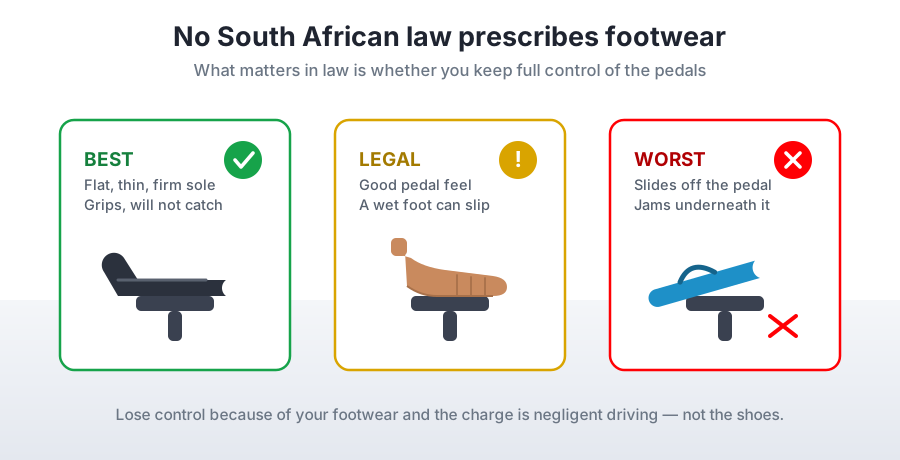
So if a loose flip-flop wedges itself under your brake pedal and you cannot stop in time, you can certainly be charged. The charge is negligent driving, because you could not control the vehicle. It is not a charge for wearing the wrong shoes.
Safest to least safe, in practice
- Best: a flat, thin, firm sole that grips the pedal and will not catch on it.
- Acceptable: barefoot. You feel the pedals well, but a wet or sweaty foot can slip off, and there is no protection in a collision.
- Worst: flip-flops, slops and high heels. These slide off, slip under the pedals and change the angle of your foot. Road-safety bodies single them out as the real hazard — far more so than bare feet.
If you are wearing unsuitable shoes and have nothing better with you, taking them off is the safer choice, and a perfectly legal one.
Motorcycles are different
Footwear is still not prescribed for a rider — but a protective helmet is compulsory by law for the rider and for any passenger. Proper boots are not a legal requirement, yet on a motorcycle your feet are exposed to the road, the exhaust and the gear lever. Every riding-gear guide in our Motor Bike Rules section treats boots as basic equipment, not an optional extra.
In the test
This comes up as a myth-buster question. If you are asked whether a driver is obliged to wear shoes, or whether driving barefoot is an offence, the answer is no. Watch for options that try to attach a fine or a demerit to footwear — none exists.